



Process
Powder coating: Process, procedure and quality factors
The powder coating process produces durable, uniform finishes for industrial components. Key factors for achieving optimal results include thorough pre-treatment, consistent application and controlled curing. Find out how this process works step by step, what powder coating methods are available, and how you can control the process to ensure quality.
Powder coating: an overview of the process
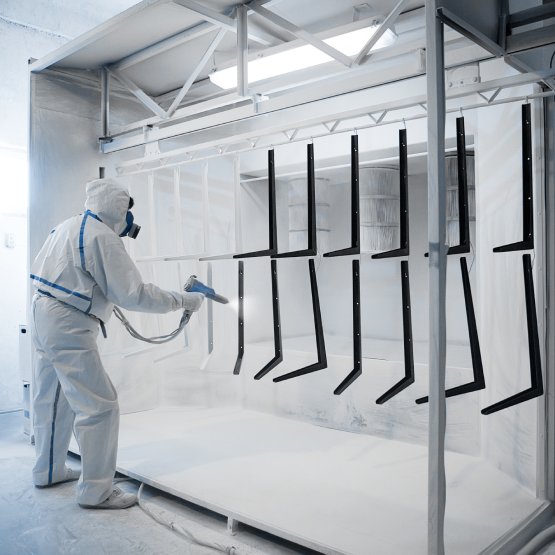
In powder coating, a powder coating is applied electrostatically to the workpiece and then cured in an oven. The result: durable coatings with a high degree of reproducibility, provided the process and material are carefully matched.
The typical powder coating process at a glance:
- Define component and requirements
- Carry out pre-treatment and cleaning
- Suspending, masking and ensuring earthing
- Apply powder (e.g. corona or tribo)
- Firing and thermal cross-linking in the kiln
- Cooling, handling and packaging
- Check quality and document the process

Step 1:
Clarify requirements, components and materials
A reliable powder coating process starts with a clear specification. Determine the loads the component must withstand. Check the material – for example, steel, galvanised steel or aluminium – to ensure that electrical conductivity is adequate. The geometry and edges also influence the coating structure and coverage.
Step 2:
Pre-treatment to ensure adhesion and corrosion protection
Pre-treatment lays the foundation for adhesion, appearance and long-lasting corrosion protection. In the powder coating process, this step typically involves cleaning and degreasing, as well as pickling where necessary, and the application of a suitable conversion coating. As an alternative or in addition, blasting is often used to thoroughly clean the surface, roughen it in a targeted manner and thus create the optimal basis for reliable adhesion of the coating. The higher the protection requirements, the more consistently the pre-treatment must be tailored to the coating system.
Step 3:
Ensure correct installation of mounting, masking and earthing
In the powder coating process, the mounting system has a direct impact on the result. Good contact points and a secure earth connection ensure a stable electrostatic field distribution and enable an even coating to form. Masking protects areas that must remain uncoated, such as threads, sealing surfaces or mating surfaces, so that assembly can be carried out successfully later without the need for rework.
Step 4:
Storing and applying the powder – application in the booth
In the standard process, powder coating is applied electrostatically using a spray gun – either manually or automatically. Factors such as powder feed rate, gun distance, voltage and current, air flow and booth configuration determine the uniformity of the finish.
Powder handling is also important prior to application: Powder coatings should be stored in a cool, dry place, protected from moisture, and only applied within the temperature range specified in the technical data sheet (e.g. in the original container for up to 36 months at 5 to 25 °C). This ensures that coating quality and workability remain consistent.
Common powder coating processes:
- Corona process: Clearly dominates in the industrial sector. The powder is charged in an electric field and drawn towards the earthed workpiece.
- Tribo-coating: This is more of a niche process for specific geometries and surfaces. The powder becomes charged by friction within the gun and is then deposited, causing it to adhere to the workpiece electrostatically.
The choice of powder coating process depends on the component geometry, surface, plant design and quality requirements.
Step 5:
Baking and curing – focusing on temperature, time and the component
Nach der Applikation härtet der Pulverlack im Ofen aus. Entscheidend sind dabei nicht nur die eingestellten Ofenwerte, sondern vor allem die Objekttemperatur und wirksame Haltezeit. Beides beeinflusst direkt, ob die Beschichtung ihr Einbrennfenster sicher trifft und die gewünschte Qualität erreicht.
Für das Ergebnis ist außerdem die Schichtdicke der Beschichtung relevant, weil sie Optik und Schutzwirkung beeinflusst und innerhalb der Spezifikation liegen muss. Wie schnell das Bauteil die Zieltemperatur erreicht, hängt dagegen von der Bauteildicke ab: Dünnwandige Teile heizen schneller auf, dickwandige benötigen mehr Zeit. Auf Mischgestellen steigt deshalb das Risiko für Untervernetzung oder Überhitzung, wenn Temperaturprofil und Einbrennfenster nicht sauber auf alle Bauteile abgestimmt sind.
Step 6:
Cooling, handling and packaging
After baking, the component should be allowed to cool down gradually before being stacked, packed or processed further. This will prevent pressure marks, sticking (where coated surfaces stick together) and damage during transport or assembly.
Step 7:
Quality control and documentation
In an industrial powder coating process, testing and process data go hand in hand. Typical examples include:
- Visual inspection: Appearance and finish, lustre and texture, as well as inclusions and imperfections.
- Effect creation: for example, a uniform metallic finish with effect powders.
- Coating thickness measurement
- Other tests relevant to the specifications: such as adhesion testing, depending on requirements.
- Documentation: Batches, process parameters and furnace profiles for traceable quality.
Adjustment lever for a reproducible powder coating process
Ein stabiler Pulverbeschichtung-Prozess entsteht, wenn die entscheidenden Stellschrauben sauber zusammenspielen. Besonders wirkungsvoll sind:
Component geometry
Take edge radii, degassing risks and the Faraday effect (difficulties in coating corners and recesses) into account at an early stage.
Pre-treatment
Ensure that cleanliness, the conversion coating (e.g. phosphating/chromating) and the rinse cascade are consistently maintained at the required levels.
Powder Handling and Storage
Store in a cool, dry place, keep away from moisture, and ensure that the product is used in accordance with the technical data sheet to maintain its performance and surface finish.
Application parameters
Standardise the gun distance, voltage and current, powder feed and air flow in a binding manner.
Grounding and Suspension
Check the contact points regularly and ensure that the components are securely connected.
Burning-in
Check the object temperature and dwell time, rather than relying solely on the oven readings.
Common sources of error in the powder coating process
To ensure consistent quality in powder coating processes, it is worth taking a look at the most common pitfalls. The table below shows typical sources of error for each process step and useful practical tips to help you quickly rectify any issues.
Process step | Target | Common source of errors | Practical tip |
|---|---|---|---|
Pre-treatment
| Adhesion and corrosion protection | Residual dirt, incorrect conversion | Check cleaning and rinsing values regularly |
Suspension/Earthing
| Stable deposition | Poor contact, loose suspension | Standardise and clean contact points |
Application | Even layer | Incorrect spacing, unstable conveyance | Create parameter sheets for each component family |
Burning-in | Full connectivity | Incorrect time-temperature window | Measure the object temperature and validate the oven profile |
Handling | Protect the surface | Stack pressure, packaging abrasion | Adjust the cooling time and packaging to suit the surface |
Practical checklist for powder coating processes
If common sources of error are identified, they can often be avoided by following a few simple guidelines. The following checklist will help you to ensure the powder coating process is carried out correctly, step by step, before any deviations occur.
Have the component requirements and powder coating system been clearly defined?
Is the pre-treatment suitable for the substrate and the required durability?
Are mounting, shielding, and grounding reproducible for each rack?
Are the application parameters documented and consistent for mass production?
Is the burn-in window defined by the object temperature and dwell time?
Are the coating thickness, appearance, and adhesion documented with specific test criteria?
System expertise for your powder coating process
Sie möchten Ihr Pulverbeschichtung-Verfahren absichern, ein robustes Pulverlacksystem auswählen oder Ihren Pulverbeschichtung-Prozess auf Serienqualität ausrichten? FreiLacke entwickelt Pulverlacke und Lacksysteme mit dem Systemlack-Gedanken unter einem Dach und unterstützt Sie von der Spezifikation bis zur Prozessoptimierung.
Discover our powder coating solutions
Cost-effective, environmentally friendly and highly durable.
Our key areas of focus as paint manufacturers